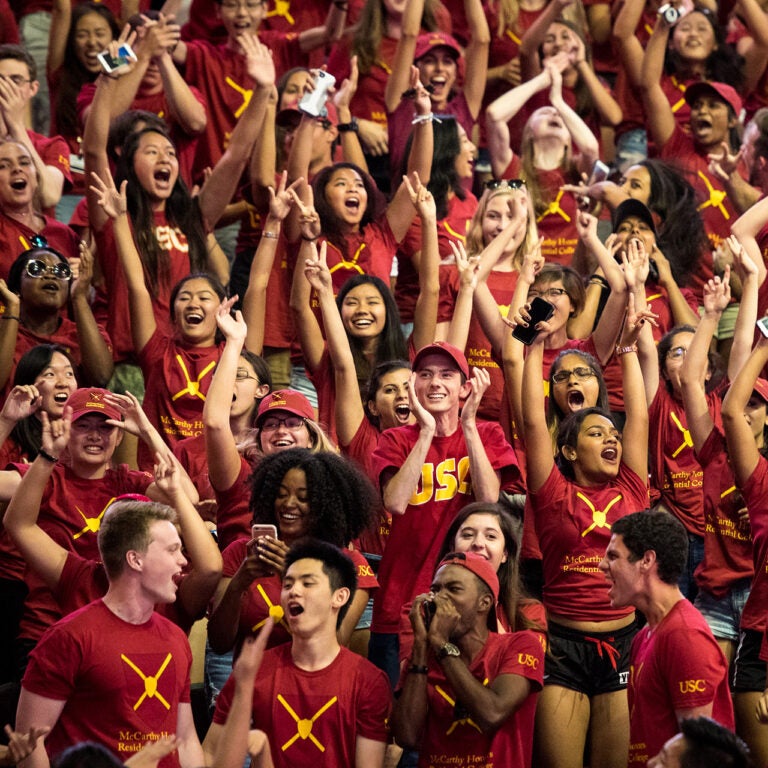
Graduate & Professional Degrees
The University of Southern California is one of the top-ranked universities in the country and offers a diverse range of graduate and professional programs to suit various career pursuits. Students can gain access to exceptional academic scholarship, accelerated degrees, top faculty, leading research opportunities and collaborative learning communities. With state-of-the-art facilities and competitive faculty and staff committed to excellence, USC's graduate and professional programs serve as an attractive option for those seeking higher education on the West Coast.
-
Master's Degree | Keck School of Medicine of USC
The Master of Science in Pain Medicine is an online program with a total 27 courses (33 academic units), specifically designed for the practicing professional who wants to improve skills and gain expertise to deliver the best care for patients with complex pain conditions. The curriculum is designed with a series of didactic courses in which students will gain knowledge about the diagnosis, pathobiology and management of pain conditions. The goal of this postdoctoral three-year master program is to give practicing health care providers advanced clinical, didactic, and evidence-based education in the field of Pain Medicine. The first year provides a foundation that years two and three build upon, giving the non-physicians the necessary background for the following two years. Nevertheless, physicians will also found the first year to be important to be a meaningful educational experience.
The students participate in weekly live online sessions with faculty and other program students, ensuring a collaborative and social learning experience. There are 2-3 courses per trimester, with 2-4 streaming video lectures for viewing each week. After each video lecture students complete an associated online quiz (comprising multiple choice, short answer or fill-in questions).
Students need to complete 3 units of elective courses.
-
Graduate Certificate | Keck School of Medicine of USC
The certificate program in Pain Science is a program with eight courses (12 academic units), specifically designed for the non-clinical professional who wants to improve skills and gain expertise in the field of chronic pain.
-
Graduate Certificate | USC Alfred E. Mann School of Pharmacy and Pharmaceutical Sciences
The graduate certificate in patient and product safety is a 12-unit program (four course minimum) that educates students in the emerging field of safety and risk management in the health care environment. It is designed to produce graduates who have a particular expertise in the evaluation and mitigation of medical errors and health-care product problems. Course work is typically delivered in nontraditional formats such as intensive weekend sessions and will use distance learning tools, video streamed lectures, and study materials. Courses can be taken on site, by distance or as a blended combination. Students should confirm their specific course work plan in consultation with the graduate advisers before beginning the program. Students who have bachelor's degrees from accredited colleges or universities must submit an application for graduate study through the regulatory science program of the Mann School of Pharmacy and Pharmaceutical Sciences. GRE scores are not required for admission to the certificate program. Students are expected to enroll each semester until the program is completed.
Students must complete 12 units of specified course work, that normally will include an introductory course in the basic principles of risk management, a second course in the use of risk management tools, and two additional courses in patient and product safety respectively as listed below. In addition, a course in medical ethics is recommended. Most students will take the courses that are listed in the sample student program below, but if students have already strong previous experience in risk management or safety, other statistical or quality courses taught in graduate programs at USC may be substituted with the permission of the program director. The certificate can be completed on a part-time basis but must be finished within five years.
Courses may be selected from the following recommended course list.
-
Doctoral Degree | USC Thornton School of Music
Overview
The DMA in Classical Guitar consists of the following areas of study: the basic DMA curriculum, course work in the major, an academic field and two elective fields.
Degree Prerequisites
DMA applicants must complete the appropriate master of music degree program or its equivalent.
Admission
Admission to Thornton programs is granted through the USC admission process. Applicants are screened by appropriate faculty selection committees. Specific entrance requirements are reviewed on an annual basis and published online at music.usc.edu.
Grade Point Average Requirements
A minimum grade point average of 3.0 (A = 4.0) is required for all graduate course units in music. A grade of B or higher is required for all courses in the major field. For courses in academic and elective fields, the minimum passing grade is C.
Transfer Credit
The Degree Progress Department in the Office of Academic Records and Registrar determines whether course work taken elsewhere is available for transfer credit. A maximum of 30 units of transfer credit may be applied toward a doctoral degree in music. Whether such credit is applicable toward a specific requirement in a major or minor field is determined by the Thornton School department in which the subject is taught, pending approval by the dean of the Thornton School. Transfer credit petitions must be filed with the Thornton doctoral adviser during the first semester in residence. Transfer work must have been completed within 10 years of admission to the DMA program to be applied toward that degree.
Residence Requirement
A minimum of two years of full-time study beyond the Master of Music degree is required for the Doctor of Musical Arts. At least one year of full-time study beyond the master's degree (6 units or more per semester) must be in residence at USC.
Time Schedule
The time limit for completing the Doctor of Musical Arts degree is eight years. For students who earned an applicable master's degree within five years prior to admission to the doctoral program, the time limit for completing the Doctor of Musical Arts degree is six years. Progress is measured from the beginning of the first course at USC applied toward the degree. Extensions will be granted by petition to the Thornton School for only the most compelling reasons.
Music Graduate Entrance Exams
All students entering a graduate-level degree program (MA, MM, DMA and PhD) at USC Thornton, who have not previously completed a degree at USC Thornton, must take a series of entrance exams in core music subjects. These exams are called Music Graduate Entrance Exams (MGEEs). Information regarding which exams are required for specific majors is available from the Thornton Student Affairs office. Also see the Thornton School of Music
Foreign Language
An academic reading knowledge of a language other than English is required of all Thornton doctoral students. This requirement can be met in any of the following ways:
- Completion of a prior degree, as verified on an official transcript, from an accredited institution of higher education at which the primary language of instruction is a language other than English.
- Completion of at least three semesters of college-level language instruction in a language other than English, as verified on an official transcript, at an accredited institution of higher education.
- Completion of one or more USC language course(s) (in a language other than English) as approved by the Thornton School.
- Earning a passing score on a written examination (in a language other than English) as approved by the Thornton School.
Departments within the Thornton School may require additional language skills. All language requirements must be fulfilled before entering the third semester in the program. Students who have engaged in extensive study of one or more languages other than English that does not meet this requirement as described above may request an exception.
Course Requirements
Each student is required to complete four areas of concentration: the major field, an academic field and two elective fields.
Required courses for each major curriculum are listed in the description of major programs below. Required courses for any academic or elective field are determined for their respective fields by the faculty advisers on a student's DMA guidance committee.
A minimum of 65 graduate units beyond the bachelor's degree are required to complete a DMA degree. Fifty-five or more units must be in music, 12 of these beyond the master's level must be in the major. At least 40 of these must be at the 500 level or higher. All course work earned under these requirements for a doctoral degree is considered to be obsolete after 10 years from the date of completion of such work and may not be used to fulfill degree requirements.
Academic and Elective Fields
For the academic field students must choose one from Musicology, Theory and Analysis, Music Teaching and Learning, Choral Music or Sacred Music. For the elective fields students will choose two fields from among 50 possible areas, including Composition, Performance, Early Music, Jazz Studies, Music Teaching and Learning, Choral Music, Sacred Music, Conducting, Pedagogy, Electroacoustic Media, Music Industry, as well as areas outside of music. The fields comprise courses that are determined by the department in which they are administered. Eight to 10 units are taken in the academic field. Six to 8 units are taken in each elective field. The academic field may not duplicate a major or an elective field. No more than two of the four fields of concentration may be under the guidance of the same department within the Thornton School of Music, and at least one of the elective fields must culminate in a substantial written paper or examination. Students must apply to their chosen fields. Admission to academic and elective fields is determined by the appropriate department, prior to the Graduate Committee Interview. Individualized programs of study will be created in each field in consultation with a faculty adviser in each area.
Graduate Committee Interview
Before the completion of 16 units beyond the master's degree and before permission to present the second doctoral recital is requested, doctoral students must meet with the Graduate Advisory Committee of the Thornton School of Music to discuss their progress in the program and their goals for the future. In preparation for this interview, students must prepare a dossier according to specific instructions available from the Thornton doctoral adviser. The committee determines the student's continuation in the program, and approves both the student's individualized curriculum (including all fields of concentration) and the members of his or her DMA guidance committee.
DMA Guidance Committee
The DMA guidance committee is composed of at least five members: two faculty members from the major department, one of whom will serve as chair, and a faculty member from each of the three other areas of concentration. At least three members of a committee must be full-time faculty of rank in the Thornton School. The composition of the DMA Guidance Committee is proposed and approved as part of the Graduate Committee Interview.
The guidance committee administers the written and oral parts of the comprehensive examination. The committee continues to serve until the comprehensive examination has been passed, the dissertation topic approved (if applicable) and the student is admitted to candidacy (if applicable). For students in curricula that require recitals, the two major field advisers serve as the recital committee and are responsible for determining the approved format, content, scheduling, and presentation of these performances for credit toward the requirements of the degree.
Comprehensive Examination
The comprehensive examination for the DMA is administered by the student's guidance committee. This examination consists of written and oral components and is designed to assess the student's mastery of his or her fields of concentration and readiness for professional independence as a performer, composer, teacher, researcher and/or scholar. The student must obtain permission from the guidance committee to take the comprehensive examination and schedule it at least two months in advance to ensure the committee's availability. The examination must be taken after completion of all required course work for all fields of concentration, except (in some cases) a limited number of the required units of Individual Instruction in the major field. In degree programs that require the presentation of four major recitals, at least two major recitals must be presented prior to the administration of the comprehensive examination. Up to two required recitals may be presented after the comprehensive examination. The dissertation (if required) must be written after the comprehensive examination. Comprehensive examinations will not be scheduled during summer sessions except under extraordinary circumstances and only with the written approval of members of the guidance committee. All portions of the examination must be completed within one month.
The comprehensive examination is comprised of a substantial culminative work for each field of concentration, as well as an oral examination with the student's guidance committee. The culminative work for each field may be a written examination, paper, project or recital, as appropriate for the particular field. For the academic field and at least one elective field, this culminative requirement must be a substantial written examination or paper. Following the successful completion of all culminative requirements and the approval of each by the corresponding faculty adviser, the student will sit for a two-hour oral examination with the guidance committee. This oral examination covers in greater depth the topics discussed in the written examinations and other requirements for the fields of concentration. The oral examination may also cover new material as determined by the guidance committee.
The two major field advisers and the academic field adviser must be present at the oral examination and render a judgment on the acceptability of the comprehensive examinations as a whole. It is highly preferable that the faculty advisers for the two elective fields participate in the oral examination with the other members of the guidance committee. If, however, there are challenges with scheduling or other issues that are reasonably unresolvable, the participation of the faculty advisers for elective fields is not required for the oral examination if they feel that the candidate has demonstrated knowledge and mastery of material that is appropriate for an elective field in their disciplines.
The examinations will be reported as passing if there is no more than one dissenting vote on the committee. A student must pass both the written and oral portions to pass the comprehensive examination. A pass on the examination cannot be made contingent upon any form of additional work.
If a student fails the comprehensive examination, the guidance committee may permit the student to repeat it once at a mutually satisfactory time within a period of not less than six months nor more than one year from the date of the first oral examination. A student may not take the comprehensive examination more than twice.
The comprehensive examination serves as the qualifying examination for programs that require a dissertation.
-
Master's Degree | USC Thornton School of Music
Overview
The MM in classical guitar is a two-year, 30-unit program consisting of individual instruction, ensembles, Baroque music, guitar history, music history and electives. Two graduate recitals are required.
Admission
Admission to Thornton programs is granted through the USC admission process. Applicants are screened by appropriate faculty selection committees. Specific entrance requirements are reviewed on an annual basis and published online at music.usc.edu.
Unit and Grade Requirements
Thirty units of graduate work are required; a minimum of 15 units (excluding thesis or project) must be at the 500 level or higher. All students must satisfy the specified requirements of their major department (see department chair or academic adviser). Students must complete at least 26 semester units at USC, including the thesis or recital. A grade point average of not less than 3.0 (A = 4.0) is required for all graduate courses in music, and a grade of B or higher is required for all courses in the major department. Students who transfer credits must achieve this average on all combined transferred and residence units.
Transferred Credits
All credits transferred must be the equivalent of corresponding current work at USC. Course work completed at another institution that has been approved by the Thornton School for transfer credit must have been completed within seven years from the date of admission to a master's degree program to be applied toward that degree. Transfer credit petitions must be filed with the appropriate Thornton adviser during the first semester in residence.
Time Limit
The time limit for completing the Master of Music degree is five years. Progress is measured from the beginning of the first course at USC applied toward the degree. Extensions will be granted by petition to the Thornton School for only the most compelling reasons.
Music Graduate Entrance Exams
All students entering a graduate-level degree program (MA, MM, DMA, PhD) at USC Thornton, who have not previously completed a degree at USC Thornton, must take a series of entrance exams in core music subjects. These exams are called Music Graduate Entrance Exams (MGEEs). Information regarding which exams are required for specific majors is available from the Thornton Student Affairs office. Also see the Thornton School of Music
Master's Recitals
Two public recitals are required of all candidates for the Master of Music degree (Classical Guitar), as indicated below. Candidates must apply for recital dates, according to the current guidelines of the Music Operations office. Some departments require that a candidate be prepared to play or conduct the recital program for the approval of a faculty committee in advance.
Comprehensive Review
Candidates for the Master of Music must pass a comprehensive review toward the end of their course of study, usually in the final semester. This review, which is administered by the faculty of the major department, consists of an oral or written examination, covering relevant aspects of musical performance, literature, and/or technique.
-
Doctoral Degree | USC Thornton School of Music
Overview
The DMA in Early Music consists of the following areas of study: the basic DMA curriculum, course work in the major, an academic field and two elective fields.
Degree Prerequisites
DMA applicants must complete the appropriate master of music degree program or its equivalent.
Admission
Admission to Thornton programs is granted through the USC admission process. Applicants are screened by appropriate faculty selection committees. Specific entrance requirements are reviewed on an annual basis and published online at music.usc.edu.
Grade Point Average Requirements
A minimum grade point average of 3.0 (A = 4.0) is required for all graduate course units in music. A grade of B or higher is required for all courses in the major field. For courses in academic and elective fields, the minimum passing grade is C.
Transfer Credit
The Degree Progress Department in the Office of Academic Records and Registrar determines whether course work taken elsewhere is available for transfer credit. A maximum of 30 units of transfer credit may be applied toward a doctoral degree in music. Whether such credit is applicable toward a specific requirement in a major or minor field is determined by the Thornton School department in which the subject is taught, pending approval by the dean of the Thornton School. Transfer credit petitions must be filed with the Thornton doctoral adviser during the first semester in residence. Transfer work must have been completed within 10 years of admission to the DMA program to be applied toward that degree.
Residence Requirement
A minimum of two years of full-time study beyond the Master of Music degree is required for the Doctor of Musical Arts. At least one year of full-time study beyond the master's degree (6 units or more per semester) must be in residence at USC.
Time Schedule
The time limit for completing the Doctor of Musical Arts degree is eight years. For students who earned an applicable master's degree within five years prior to admission to the doctoral program, the time limit for completing the Doctor of Musical Arts degree is six years. Progress is measured from the beginning of the first course at USC applied toward the degree. Extensions will be granted by petition to the Thornton School for only the most compelling reasons.
Music Graduate Entrance Exams
All students entering a graduate-level degree program (MA, MM, DMA and PhD) at USC Thornton, who have not previously completed a degree at USC Thornton, must take a series of entrance exams in core music subjects. These exams are called Music Graduate Entrance Exams (MGEEs). Information regarding which exams are required for specific majors is available from the Thornton Student Affairs office. Also see the Thornton School of Music
Foreign Language
An academic reading knowledge of a language other than English is required of all Thornton doctoral students. This requirement can be met in any of the following ways:
- Completion of a prior degree, as verified on an official transcript, from an accredited institution of higher education at which the primary language of instruction is a language other than English.
- Completion of at least three semesters of college-level language instruction in a language other than English, as verified on an official transcript, at an accredited institution of higher education.
- Completion of one or more USC language course(s) (in a language other than English) as approved by the Thornton School.
- Earning a passing score on a written examination (in a language other than English) as approved by the Thornton School.
Departments within the Thornton School may require additional language skills. All language requirements must be fulfilled before entering the third semester in the program. Students who have engaged in extensive study of one or more languages other than English that does not meet this requirement as described above may request an exception.
Course Requirements
Each student is required to complete four areas of concentration: the major field, an academic field and two elective fields.
Required courses for each major curriculum are listed in the description of major programs below. Required courses for any academic or elective field are determined for their respective fields by the faculty advisers on a student's DMA guidance committee.
A minimum of 65 graduate units beyond the bachelor's degree are required to complete a DMA degree. Fifty-five or more units must be in music, 12 of these beyond the master's level must be in the major. At least 40 of these must be at the 500 level or higher. All course work earned under these requirements for a doctoral degree is considered to be obsolete after 10 years from the date of completion of such work and may not be used to fulfill degree requirements.
Academic and Elective Fields
For the academic field students must choose one from Musicology, Theory and Analysis, Music Teaching and Learning, Choral Music or Sacred Music. For the elective fields students will choose two fields from among 50 possible areas, including Composition, Performance, Early Music, Jazz Studies, Music Teaching and Learning, Choral Music, Sacred Music, Conducting, Pedagogy, Electroacoustic Media, Music Industry, as well as areas outside of music. The fields comprise courses that are determined by the department in which they are administered. Eight to 10 units are taken in the academic field. Six to 8 units are taken in each elective field. The academic field may not duplicate a major or an elective field. No more than two of the four fields of concentration may be under the guidance of the same department within the Thornton School of Music, and at least one of the elective fields must culminate in a substantial written paper or examination. Students must apply to their chosen fields. Admission to academic and elective fields is determined by the appropriate department, prior to the Graduate Committee Interview. Individualized programs of study will be created in each field in consultation with a faculty adviser in each area.
Graduate Committee Interview
Before the completion of 16 units beyond the master's degree and before permission to present the second doctoral recital is requested, doctoral students must meet with the Graduate Advisory Committee of the Thornton School of Music to discuss their progress in the program and their goals for the future. In preparation for this interview, students must prepare a dossier according to specific instructions available from the Thornton doctoral adviser. The committee determines the student's continuation in the program, and approves both the student's individualized curriculum (including all fields of concentration) and the members of his or her DMA guidance committee.
DMA Guidance Committee
The DMA guidance committee is composed of at least five members: two faculty members from the major department, one of whom will serve as chair, and a faculty member from each of the three other areas of concentration. At least three members of a committee must be full-time faculty of rank in the Thornton School. The composition of the DMA Guidance Committee is proposed and approved as part of the Graduate Committee Interview.
The guidance committee administers the written and oral parts of the comprehensive examination. The committee continues to serve until the comprehensive examination has been passed, the dissertation topic approved (if applicable) and the student is admitted to candidacy (if applicable). For students in curricula that require recitals, the two major field advisers serve as the recital committee and are responsible for determining the approved format, content, scheduling, and presentation of these performances for credit toward the requirements of the degree.
Comprehensive Examination
The comprehensive examination for the DMA is administered by the student's guidance committee. This examination consists of written and oral components and is designed to assess the student's mastery of his or her fields of concentration and readiness for professional independence as a performer, composer, teacher, researcher and/or scholar. The student must obtain permission from the guidance committee to take the comprehensive examination and schedule it at least two months in advance to ensure the committee's availability. The examination must be taken after completion of all required course work for all fields of concentration, except (in some cases) a limited number of the required units of Individual Instruction in the major field. In degree programs that require the presentation of four major recitals, at least two major recitals must be presented prior to the administration of the comprehensive examination. Up to two required recitals may be presented after the comprehensive examination. The dissertation (if required) must be written after the comprehensive examination. Comprehensive examinations will not be scheduled during summer sessions except under extraordinary circumstances and only with the written approval of members of the guidance committee. All portions of the examination must be completed within one month.
The comprehensive examination is comprised of a substantial culminative work for each field of concentration, as well as an oral examination with the student's guidance committee. The culminative work for each field may be a written examination, paper, project or recital, as appropriate for the particular field. For the academic field and at least one elective field, this culminative requirement must be a substantial written examination or paper. Following the successful completion of all culminative requirements and the approval of each by the corresponding faculty adviser, the student will sit for a two-hour oral examination with the guidance committee. This oral examination covers in greater depth the topics discussed in the written examinations and other requirements for the fields of concentration. The oral examination may also cover new material as determined by the guidance committee.
The two major field advisers and the academic field adviser must be present at the oral examination and render a judgment on the acceptability of the comprehensive examinations as a whole. It is highly preferable that the faculty advisers for the two elective fields participate in the oral examination with the other members of the guidance committee. If, however, there are challenges with scheduling or other issues that are reasonably unresolvable, the participation of the faculty advisers for elective fields is not required for the oral examination if they feel that the candidate has demonstrated knowledge and mastery of material that is appropriate for an elective field in their disciplines.
The examinations will be reported as passing if there is no more than one dissenting vote on the committee. A student must pass both the written and oral portions to pass the comprehensive examination. A pass on the examination cannot be made contingent upon any form of additional work.
If a student fails the comprehensive examination, the guidance committee may permit the student to repeat it once at a mutually satisfactory time within a period of not less than six months nor more than one year from the date of the first oral examination. A student may not take the comprehensive examination more than twice.
The comprehensive examination serves as the qualifying examination for programs that require a dissertation.
-
Master's Degree | USC Thornton School of Music
Overview
The MM in winds and percussion performance is a two-year, 30-unit program consisting of individual instruction, wind ensemble, chamber music, conducting, music history and electives. One graduate recital is required.
Admission
Admission to Thornton programs is granted through the USC admission process. Applicants are screened by appropriate faculty selection committees. Specific entrance requirements are reviewed on an annual basis and published online at music.usc.edu.
Unit and Grade Requirements
Students must complete at least 26 semester units at USC, including the thesis or recital. A grade point average of not less than 3.0 (A = 4.0) is required for all graduate courses in music, and a grade of B or higher is required for all courses in the major department. Students who transfer credits must achieve this average on all combined transferred and residence units.
Transferred Credits
All credits transferred must be the equivalent of corresponding current work at USC. Course work completed at another institution that has been approved by the Thornton School for transfer credit must have been completed within seven years from the date of admission to a master's degree program to be applied toward that degree. Transfer credit petitions must be filed with the appropriate Thornton adviser during the first semester in residence.
Time Limit
The time limit for completing the Master of Music degree is five years. Progress is measured from the beginning of the first course at USC applied toward the degree. Extensions will be granted by petition to the Thornton School for only the most compelling reasons.
Music Graduate Entrance Exams
All students entering a graduate-level degree program (MA, MM, DMA, PhD) at USC Thornton, who have not previously completed a degree at USC Thornton, must take a series of entrance exams in core music subjects. These exams are called Music Graduate Entrance Exams (MGEEs). Information regarding which exams are required for specific majors is available from the Thornton Student Affairs office. Also see the Thornton School of Music
Master's Recital
One public recital is required of all candidates for the Master of Music degree, as indicated below. Candidates must apply for recital dates, according to the current guidelines of the Music Operations office. Some departments require that a candidate be prepared to play or conduct the recital program for the approval of a faculty committee in advance.
Comprehensive Review
Candidates for the Master of Music must pass a comprehensive review toward the end of their course of study, usually in the final semester. This review, which is administered by the faculty of the major department, consists of an oral or written examination, covering relevant aspects of musical performance, literature, and/or technique.
-
Graduate Certificate | USC Thornton School of Music
This two-year graduate-level program is designed for students who have completed their undergraduate education in music, or its equivalent, and intend to concentrate their energies on the full-time development of their discipline.
Entrance Requirements
A performance audition is required with repertory to be determined by the student's primary department.
Curriculum Requirements
The requirements for this program consist of 16 units of Graduate Certificate Performance (4 units per semester of
-
Doctoral Degree | USC Thornton School of Music
Overview
The DMA in Keyboard Collaborative Arts consists of the following areas of study: the basic DMA curriculum, course work in the major, an academic field and two elective fields.
Degree Prerequisites
DMA applicants must complete the appropriate master of music degree program or its equivalent.
Admission
Admission to Thornton programs is granted through the USC admission process. Applicants are screened by appropriate faculty selection committees. Specific entrance requirements are reviewed on an annual basis and published online at music.usc.edu.
Grade Point Average Requirements
A minimum grade point average of 3.0 (A = 4.0) is required for all graduate course units in music. A grade of B or higher is required for all courses in the major field. For courses in academic and elective fields, the minimum passing grade is C.
Transfer Credit
The Degree Progress Department in the Office of Academic Records and Registrar determines whether course work taken elsewhere is available for transfer credit. A maximum of 30 units of transfer credit may be applied toward a doctoral degree in music. Whether such credit is applicable toward a specific requirement in a major or minor field is determined by the Thornton School department in which the subject is taught, pending approval by the dean of the Thornton School. Transfer credit petitions must be filed with the Thornton doctoral adviser during the first semester in residence. Transfer work must have been completed within 10 years of admission to the DMA program to be applied toward that degree.
Residence Requirement
A minimum of two years of full-time study beyond the Master of Music degree is required for the Doctor of Musical Arts. At least one year of full-time study beyond the master's degree (6 units or more per semester) must be in residence at USC.
Time Schedule
The time limit for completing the Doctor of Musical Arts degree is eight years. For students who earned an applicable master's degree within five years prior to admission to the doctoral program, the time limit for completing the Doctor of Musical Arts degree is six years. Progress is measured from the beginning of the first course at USC applied toward the degree. Extensions will be granted by petition to the Thornton School for only the most compelling reasons.
Music Graduate Entrance Exams
All students entering a graduate-level degree program (MA, MM, DMA and PhD) at USC Thornton, who have not previously completed a degree at USC Thornton, must take a series of entrance exams in core music subjects. These exams are called Music Graduate Entrance Exams (MGEEs). Information regarding which exams are required for specific majors is available from the Thornton Student Affairs office. Also see the Thornton School of Music
Foreign Language
An academic reading knowledge of a language other than English is required of all Thornton doctoral students. This requirement can be met in any of the following ways:
- Completion of a prior degree, as verified on an official transcript, from an accredited institution of higher education at which the primary language of instruction is a language other than English.
- Completion of at least three semesters of college-level language instruction in a language other than English, as verified on an official transcript, at an accredited institution of higher education.
- Completion of one or more USC language course(s) (in a language other than English) as approved by the Thornton School.
- Earning a passing score on a written examination (in a language other than English) as approved by the Thornton School.
Departments within the Thornton School may require additional language skills. All language requirements must be fulfilled before entering the third semester in the program. Students who have engaged in extensive study of one or more languages other than English that does not meet this requirement as described above may request an exception.
Course Requirements
Each student is required to complete four areas of concentration: the major field, an academic field and two elective fields.
Required courses for each major curriculum are listed in the description of major programs below. Required courses for any academic or elective field are determined for their respective fields by the faculty advisers on a student's DMA guidance committee.
A minimum of 65 graduate units beyond the bachelor's degree are required to complete a DMA degree. Fifty-five or more units must be in music, 12 of these beyond the master's level must be in the major. At least 40 of these must be at the 500 level or higher. All course work earned under these requirements for a doctoral degree is considered to be obsolete after 10 years from the date of completion of such work and may not be used to fulfill degree requirements.
Academic and Elective Fields
For the academic field students must choose one from Musicology, Theory and Analysis, Music Teaching and Learning, Choral Music or Sacred Music. For the elective fields students will choose two fields from among 50 possible areas, including Composition, Performance, Early Music, Jazz Studies, Music Teaching and Learning, Choral Music, Sacred Music, Conducting, Pedagogy, Electroacoustic Media, Music Industry, as well as areas outside of music. The fields comprise courses that are determined by the department in which they are administered. Eight to 10 units are taken in the academic field. Six to 8 units are taken in each elective field. The academic field may not duplicate a major or an elective field. No more than two of the four fields of concentration may be under the guidance of the same department within the Thornton School of Music, and at least one of the elective fields must culminate in a substantial written paper or examination. Students must apply to their chosen fields. Admission to academic and elective fields is determined by the appropriate department, prior to the Graduate Committee Interview. Individualized programs of study will be created in each field in consultation with a faculty adviser in each area.
Graduate Committee Interview
Before the completion of 16 units beyond the master's degree and before permission to present the second doctoral recital is requested, doctoral students must meet with the Graduate Advisory Committee of the Thornton School of Music to discuss their progress in the program and their goals for the future. In preparation for this interview, students must prepare a dossier according to specific instructions available from the Thornton doctoral adviser. The committee determines the student's continuation in the program, and approves both the student's individualized curriculum (including all fields of concentration) and the members of his or her DMA guidance committee.
DMA Guidance Committee
The DMA guidance committee is composed of at least five members: two faculty members from the major department, one of whom will serve as chair, and a faculty member from each of the three other areas of concentration. At least three members of a committee must be full-time faculty of rank in the Thornton School. The composition of the DMA Guidance Committee is proposed and approved as part of the Graduate Committee Interview.
The guidance committee administers the written and oral parts of the comprehensive examination. The committee continues to serve until the comprehensive examination has been passed, the dissertation topic approved (if applicable) and the student is admitted to candidacy (if applicable). For students in curricula that require recitals, the two major field advisers serve as the recital committee and are responsible for determining the approved format, content, scheduling, and presentation of these performances for credit toward the requirements of the degree.
Comprehensive Examination
The comprehensive examination for the DMA is administered by the student's guidance committee. This examination consists of written and oral components and is designed to assess the student's mastery of his or her fields of concentration and readiness for professional independence as a performer, composer, teacher, researcher and/or scholar. The student must obtain permission from the guidance committee to take the comprehensive examination and schedule it at least two months in advance to ensure the committee's availability. The examination must be taken after completion of all required course work for all fields of concentration, except (in some cases) a limited number of the required units of Individual Instruction in the major field. In degree programs that require the presentation of four major recitals, at least two major recitals must be presented prior to the administration of the comprehensive examination. Up to two required recitals may be presented after the comprehensive examination. The dissertation (if required) must be written after the comprehensive examination. Comprehensive examinations will not be scheduled during summer sessions except under extraordinary circumstances and only with the written approval of members of the guidance committee. All portions of the examination must be completed within one month.
The comprehensive examination is comprised of a substantial culminative work for each field of concentration, as well as an oral examination with the student's guidance committee. The culminative work for each field may be a written examination, paper, project or recital, as appropriate for the particular field. For the academic field and at least one elective field, this culminative requirement must be a substantial written examination or paper. Following the successful completion of all culminative requirements and the approval of each by the corresponding faculty adviser, the student will sit for a two-hour oral examination with the guidance committee. This oral examination covers in greater depth the topics discussed in the written examinations and other requirements for the fields of concentration. The oral examination may also cover new material as determined by the guidance committee.
The two major field advisers and the academic field adviser must be present at the oral examination and render a judgment on the acceptability of the comprehensive examinations as a whole. It is highly preferable that the faculty advisers for the two elective fields participate in the oral examination with the other members of the guidance committee. If, however, there are challenges with scheduling or other issues that are reasonably unresolvable, the participation of the faculty advisers for elective fields is not required for the oral examination if they feel that the candidate has demonstrated knowledge and mastery of material that is appropriate for an elective field in their disciplines.
The examinations will be reported as passing if there is no more than one dissenting vote on the committee. A student must pass both the written and oral portions to pass the comprehensive examination. A pass on the examination cannot be made contingent upon any form of additional work.
If a student fails the comprehensive examination, the guidance committee may permit the student to repeat it once at a mutually satisfactory time within a period of not less than six months nor more than one year from the date of the first oral examination. A student may not take the comprehensive examination more than twice.
The comprehensive examination serves as the qualifying examination for programs that require a dissertation.
-